Knowing When To Act: Temporal Interpretation - The Underrated But Critical Ingredient In Proactive AI Agents
Knowing When To Act: The Underrated But Critical Ingredient In Proactive AI Agents

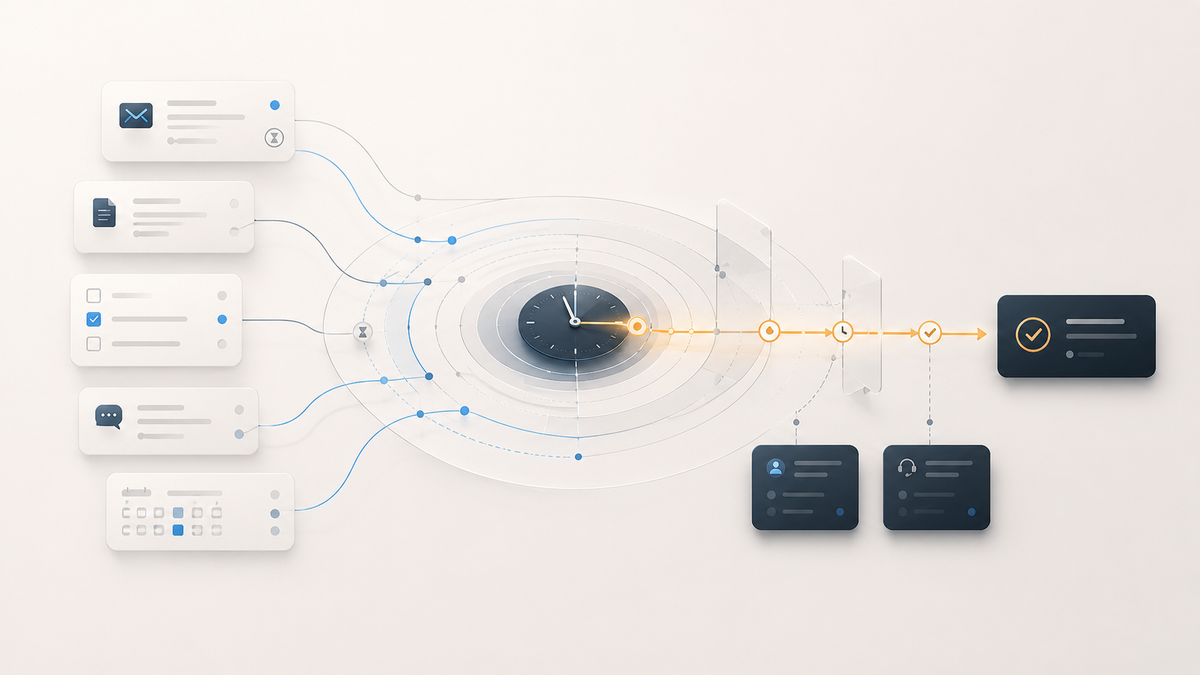
Unlike typical AI agents that require instructions to start a task, proactive AI agents act as assistants that no longer wait for directives. These agents monitor your systems, remember what is important, follow up on tasks, draft communications, escalate issues, schedule activities, summarize information, and push work forward before you even ask them to do so. It sounds like a dream.
However, there's an uncomfortable truth about getting proactive agents to reliably interpret and execute tasks for you: an agent that acts too frequently can become annoying, one that acts too soon can be risky, and one that acts too late is ineffective.
The real challenge is not just creating agents that can take action; it is building agents that understand when to act. This understanding turns out to be one of the least discussed yet most critical factors in making proactive AI agents truly useful.
Proactivity Is Not Background Execution
A reactive agent responds to user prompts. You might ask it to summarize a document, draft an email, analyze a spreadsheet, or search through a database. In this case, the user initiates the action.
On the other hand, a proactive agent faces a more challenging task. It must identify situations occurring now that could be important later. For example:
- A customer says, “Check back after budget approval.”
- A contract will renew in 90 days.
- A support ticket has remained untouched for 24 hours.
- A candidate mentions they will send their availability early next week.
- A document arrives after a decision has already been made.
- A project is stalled until legal approval is obtained.
None of these scenarios involves straightforward commands; rather, they are signals about future actions. This is where many agent architectures struggle. Relying solely on memory and tools is insufficient for effective proactive decision-making.
Memory Tells You What Happened, But Not When It Matters
A record-keeping system can store a wide range of information, including emails, documents, transcripts, tickets, tasks, CRM notes, calendar events, product specifications, and contract metadata. Modern agents can access and analyze this context.
However, merely storing context does not equate to interpreting it. For example, if an agent encounters the phrase “let’s revisit this next quarter,” it faces several questions:
- Should it create a task?
- Should it set a reminder?
- Should it wait until the beginning of the quarter?
- Should it ask for clarification on what “this” refers to?
- Should it verify whether the topic has already been resolved?
- Should it take no action, considering the phrase was casual?
The appropriate response depends on interpretation. This represents the crucial middle layer that exists between understanding the current state and executing an action. One of the most vital aspects of this layer is the Temporal Interpretation.
Calendar Instructions vs. Dates
Most software treats time as a date-parsing problem. For example:
- “Next Friday” becomes a specific calendar date.
- “90 days from now” turns into a reminder.
- “Quarterly” results in a recurring event.
While this functionality is useful, it is not sufficient for proactive agents. A proactive agent requires more than just a date; it needs what I call a Calendar Instruction grounded in its Temporal Interpretation.
A Calendar Instruction addresses several key questions:
- When should this information become relevant again?
- What should be checked at that time?
- What context should be considered?
- What should happen if there have been no changes?
- What evidence would indicate that the agent can stop following up?
For instance, consider the statement:
“Let’s revisit pricing after the board meeting.”
Although no specific date is mentioned, there is still a clear temporal instruction. The agent should not activate on a fixed calendar date; rather, it should respond after the event occurs. It should recognize that “board meeting completed” is the trigger, “pricing” is the subject, and the subsequent action might involve preparing a review or asking the owner whether a decision has been made.
This approach provides a much richer context than merely extracting dates. However, this complexity also introduces challenges, as real-world time is often unpredictable.
The Many Shapes of Time
Humans often discuss time casually because they understand its context. However, agents do not have that same understanding automatically.
cause them to
When someone says, “I already sent that last week,” it may not indicate a future task at all; instead, it could be a way to close an existing loop. This complexity is why proactive agents cannot merely extract every time-related phrase and create reminders from them. Poor interpretation of time can lead to ineffective proactivity.
For instance, an agent might follow up after a client has already responded, or impose hard deadlines based on vague language. It may remind individuals of canceled tasks and cause them to overlook dependencies due to the absence of specific dates. Additionally, it could treat broad goals as immediate tasks and wake up without a clear idea of what to check.
At that point, the agent isn't being proactive; it’s just causing unnecessary noise. The more effective approach is to treat time as evidence, rather than making guesses about it.
Temporal Evidence Before Temporal Action
When an agent encounters a time signal, it must preserve the context of what was said. For instance:
{
"raw_temporal_text": "next quarter",
"temporal_type": "period_window",
"anchor": "message_date",
"window_start": "2026-07-01",
"window_end": "2026-09-30",
"wake_at": "2026-07-01",
"confidence": 0.74,
"needs_confirmation": false
}
The raw phrase is important. The anchor is significant. The confidence level matters. It is crucial to differentiate between a date, a window, a recurrence, and the trigger for an event.
However, this information alone is not enough. The agent also requires an execution boundary:
{
"condition_to_check": "Has this topic already been resolved?",
"action_if_unresolved": "Draft a follow-up for approval.",
"stop_condition": "The topic has been handled, canceled, or superseded."
}
With this additional boundary, the agent possesses more than just a reminder; it has a defined set of future instructions. The concept of boundedness is what distinguishes useful proactivity from potentially dangerous autonomy.
The Future Attention Contract
A broad prompt like “stay on top of this customer relationship” allows an agent too much freedom to improvise. The agent can decide what matters, when to act, who to contact, and what qualifies as completed. While this may work in demonstrations, it becomes risky in real workflows.
A better approach is a "future attention contract." This model operates as follows:
- At a specific time or event T,
- Load the relevant context K,
- Check the specified condition C,
- Take only the allowed actions A,
- Require approval where necessary,
- Stop when the resolution criteria R are met.
For example:
- If the customer has not responded by next Friday:
- Check the email thread and CRM notes.
- If the issue is unresolved, draft a follow-up message for the account owner.
- Do not send the message automatically.
- Close the loop if a response already exists.
This model still allows for agency; the agent can reason, inspect tools, and prepare work. However, it is not free-form autonomy but rather bounded autonomy.
The interpretation layer provides the execution layer with a contract. This contract specifies when to activate, what to inspect, what actions it may take, what it must avoid, and when to cease operations.
This architectural framework is essential for proactive agents aiming to function effectively within real organizations.
Knowing When Not to Act
The most effective proactive agent is not necessarily the one that acts the most. Instead, it is the one that acts at the right time, in the right context, and with the appropriate level of permission.
Sometimes, this means drafting a follow-up. Other times, it involves escalating an issue, asking for clarification, or simply waiting. In some cases, doing nothing is the best course of action because the issue has already been resolved. This is a critical aspect we often overlook.
Knowing when to take action also means understanding when not to act. If the timing is unclear, ask for clarification. If ownership of a task is ambiguous, seek guidance. If a dependency is still blocked, it's best to wait. If an event has already occurred, update the status accordingly. If a task has been superseded, stop bringing it up.
By applying this thoughtful approach, agents can transition from being mere notification systems to becoming valuable coworkers. This is not because they possess human-like empathy, but because they can maintain structured attention over time.
Conclusion
The next generation of proactive agents will not be defined solely by better models, enhanced tools, or larger memory stores. While these elements are important, they are not enough on their own.
The key to unlocking their full potential lies in interpretation. Within this realm, temporal interpretation poses one of the most challenging and crucial issues.
Memory informs an agent about past events, while tools enable the agent to perform tasks. However, it is the temporal interpretation that determines when a specific memory should be reactivated. Without this capability, proactive agents risk becoming mere passive archives or ineffective reminder bots.
With temporal interpretation, they can perform much more valuable functions: they can wait, observe, reassess, act when necessary, and know when to stop once a task is complete. This aspect is the often-overlooked yet essential ingredient in proactive AI agents, not the constant pursuit of action, but the wisdom of knowing when to act.