Path to Building Reliable Enterprise Automation


Impressive AI demonstrations often depict an agent seamlessly managing emails, documents, approvals, meetings, and internal systems in response to a simple prompt like "handle client onboarding." However, real-world deployment introduces complexities. Enterprise tasks are seldom restricted to an isolated system.
The core challenge is not that artificial intelligence lacks capability; models are proficient at drafting messages, retrieving information, completing forms, utilizing tools, and reviewing documentation. Rather, the issue stems from expecting a generalized AI model to inherently understand an organization's specific operational flow and logic. This essential institutional knowledge remains distributed across personnel, systems, communications, and institutional experience.
For enterprises seeking a reliable path toward AI workflow automation, the solution lies in adopting a "Tesla" model rather than a "Waymo" approach. Instead of attempting complete autonomy immediately, organizations should establish marginal autonomy, in which human operators continue to provide oversight. This framework addresses two objectives simultaneously:
- It delivers immediate gains in marginal productivity.
- It facilitates the collection of sufficient operational data to train proprietary models for higher levels of autonomy over time.
Organizations should begin by defining clear, bounded tasks. Employees can dynamically combine these functional blocks in their daily routines, while the system records the actual execution traces. As time progresses, these recorded histories become far more valuable than standard process diagrams because they accurately reflect the enterprise's operational dynamics.
The Failure Points of Long Workflows
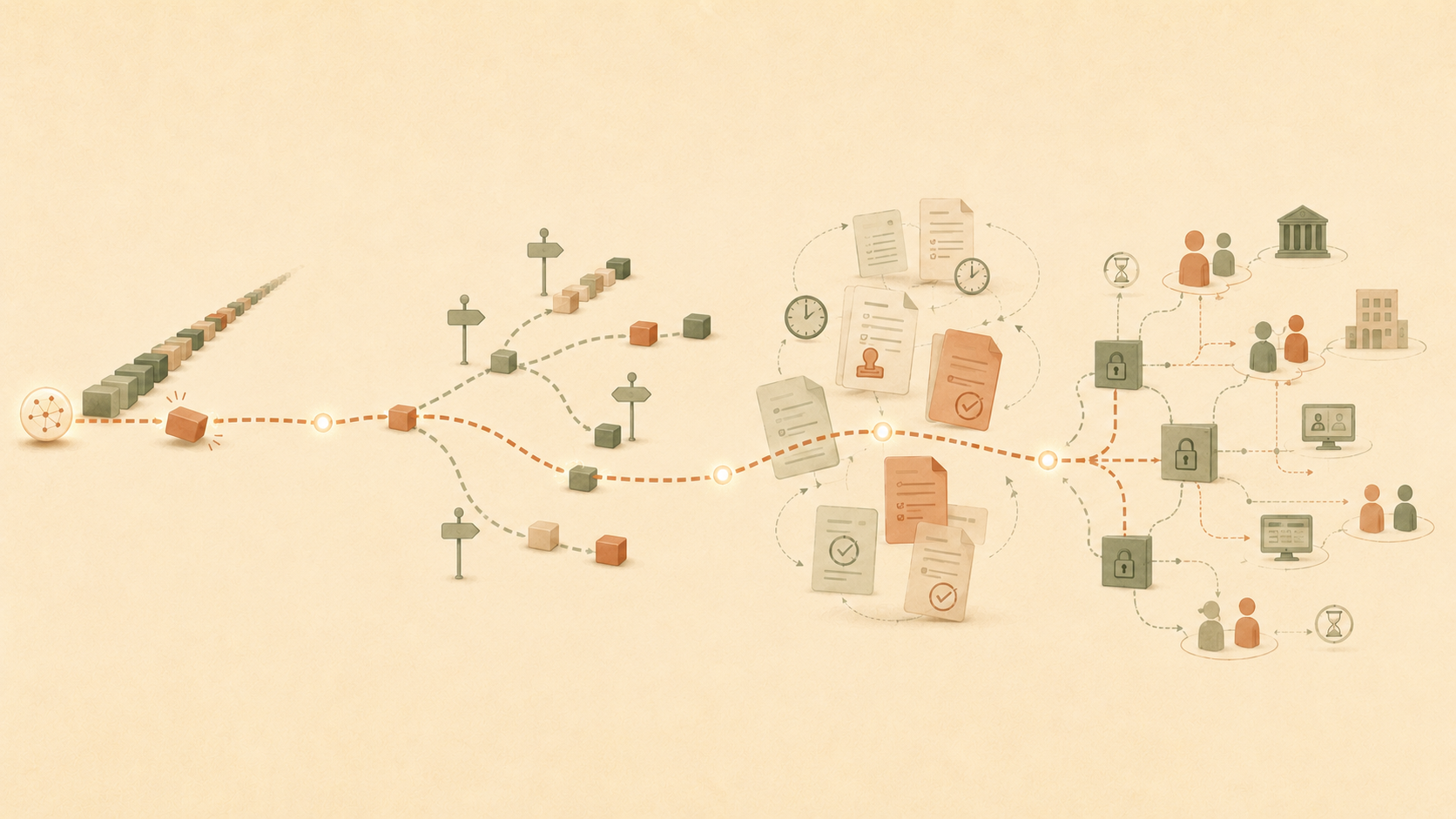
The reliability of artificial intelligence drops significantly as four specific variables scale up:
- the volume of sequential, interdependent operations;
- the ambiguity of the original prompt;
- the frequency and magnitude of state changes;
- and the count of participants, external systems, and required approvals.
Although an AI model can succeed at each individual task, managing the overall process remains a major hurdle.
Cumulative Error Progression
While an isolated error in a brief task has limited fallout, mistakes in extended workflows propagate, causing a cascade of faulty choices. For example, if an artificial intelligence erroneously treats a critical client document as optional, it proceeds without the necessary files. The system then builds a case file on incomplete details, obtains authorization, and submits the erroneous package. Even if every subsequent action is executed flawlessly, the end product is compromised. This underscores why proficiency in standalone tasks does not translate to end-to-end process reliability.
The Ambiguity of Initial Prompts
Corporate directives typically depend on implicit context that human employees easily grasp. A command such as "File the Henderson paperwork before the deadline" seems clear but leaves several pivotal details open-ended:
- Which particular Henderson account does this apply to?
- Which specific filing must be processed?
- What is the actual target deadline?
- Are any crucial documents currently missing?
- Has an extension been formally requested, or is it active?
- Who is authorized to sign off on the final submission?
Confronted with such ambiguity, an AI model must either seek clarification or speculate. While asking questions maintains accuracy at the expense of speed, unprompted assumptions risk steering the entire operation off course.
Dynamic State Shifts
Actual business workflows are rarely linear checklists. They continuously evolve as files are updated, sign-offs are rejected, timelines adjust, and client feedback arrives late. To navigate this, an automated agent must constantly track:
- completed operations;
- pending tasks;
- the latest document revisions;
- emerging variables that disrupt the active plan;
- next authorized action.
Although larger context windows allow models to hold more history, they do not guarantee the correct version is selected. Consequently, the authoritative log of workflow state must reside in a structured external ledger, rather than simple conversation transcripts.
Organizational Interdependencies
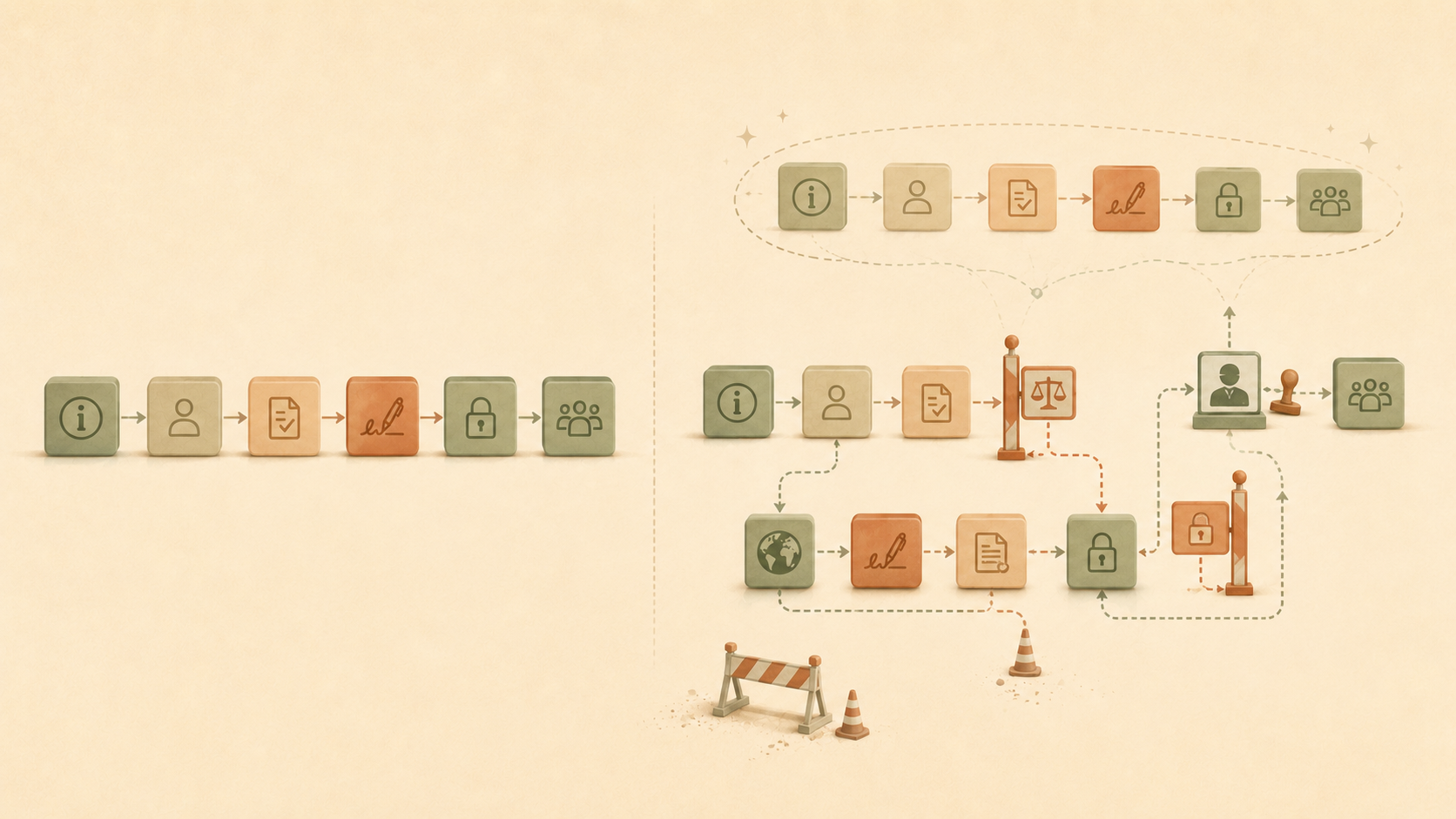
Corporate tasks are seldom restricted to an isolated system. To illustrate, client onboarding spans sales, compliance, finance, legal, IT, and external clients, each operating under distinct access rules and schedules. An AI might comprehend how to execute a step but lack the institutional context to determine if the action is organizationally valid. Ultimately, enterprise automation goes beyond simple execution logic to encompass identity, permissions, coordination, policy, and liability.
Targeting Bounded AI Competencies

A practical implementation prioritizes tasks that contemporary AI can execute with high consistency. These reliable tasks include:
- Drafting standardized email communications;
- Extracting structured data points from standard documents;
- Spotting and soliciting missing information;
- Conducting document version comparisons;
- Scheduling and coordinating group meetings;
- Producing concise text summaries;
- Routing files for official signature.
To ensure reliability, each discrete capability must be governed by five key components:
- Rigorously defined input parameters;
- A singular, clear-cut output;
- Explicit access controls and permissions;
- A concrete metric for measuring success;
- A transparent, auditable execution trail.
Employees can initiate broad workflows via text, voice, or standard user interfaces without first plotting a comprehensive workflow. Instead, they apply their professional judgment daily to determine the immediate, logical next step. While this strategy initially saves minutes rather than replacing whole roles, it is a crucial foundation: executing reliable micro-actions builds user engagement and generates the rich data required for future end-to-end automation.
Generating Proprietary Training Data.
Each time an operator decides on the next action, they supply critical context that process charts omit, such as:
- Which triggers lead to specific operations;
- Where formal sign-offs are mandatory;
- The actual duration of organizational waiting periods;
- The parameters that govern exceptions, and
- Which operational pathways are relevant to particular scenarios?
Rather than serving as passive observers, human operators actively feed organizational logic into the automation platform. This drives a multi-stage transition toward autonomous operations:
- Operators manually trigger every subsequent step.
- The platform begins recommending the most logical next action.
- Operators review and approve suggested sequences.
- The system runs stabilized processes independently under supervision.
- Well-defined procedures are delegated within set operational parameters.
- Human operators pivot to managing exceptions and high-value decisions.
The ultimate objective is not permanent manual oversight but the establishment of an empirical foundation for gradual task delegation.
Transforming Daily Operations into Actionable Records

Every completed workflow provides a chance to produce an execution trace. A high-quality trace should document:
- The original business request;
- The complete sequence of actions performed;
- All relevant documentation and data;
- Any modifications, approvals, or rejected edits;
- The rationale for any corrections made;
- Unexpected exceptions along with their recovery steps;
- And, ultimately, the final business outcome.
Transforming Unfamiliar Prompts into Learning Experiences
When faced with an unmapped request such as "Execute the quarterly compliance review", the automation platform avoids making assumptions. Instead, it prompts the operator for guidance: "A verified workflow for this action does not exist yet. Kindly lead me through the steps."
As the employee executes the task using standard, pre-approved actions, the system tracks the exact path taken. Once complete, the user is prompted to save the sequence, automatically documenting decision branches and required approval checkpoints. This turns process documentation into a natural byproduct of daily execution rather than a tedious administrative chore. While successful runs establish standard paths, corrections are even more valuable for defining operational boundaries.
For instance, if an operator modifies an AI-drafted reminder by saying, "Do not mention the late fee until the second notice," this intervention reveals three critical constraints:
- The initially generated text was inappropriate for the current stage;
- The late-fee policy is structurally tied to a specific reminder level, and
- This underlying logic must guide similar future interactions.
To capture these insights, the system must record both the correction itself and the rationale behind it. Over time, aggregating these minor adjustments builds a rich repository of institutional knowledge and corporate judgment.
Prioritizing Process Libraries Over Model Training

An organization's primary strategic value lies in a structured process repository rather than a highly tuned model. This governed database archives:
- documented workflow designs;
- successful execution paths;
- operational failures and system exceptions;
- key decision branches and approvals;
- manual corrections and intervention histories;
- and ultimate business outcomes.
Initially, this library serves to facilitate:
- executable process configurations;
- guidance on subsequent actions;
- reference cases for comparable scenarios;
- assessments of model performance;
- irregularity detection and overall procedural optimization.
Model fine-tuning must be reserved for stable, repetitive, and well-structured workflows. Crucial parameters, including authorizations, deadlines, compliance standards, and legal bounds, should remain transparent and externalized from the model. While AI can recommend workflows based on user preferences, a rule-based engine must enforce policies. Ultimately, human operators must resolve exceptions and sign off on high-impact actions.
Recommended Best Practices
- Ensure all functional blocks are self-contained and auditable.
- Explicitly declare every critical underlying operational assumption.
- Distinguish actual operational practices from official policies.
- Document the specific reasoning behind manual edits rather than just saving final corrected results.
- Adopt the terminology your workforce uses natively.
- Track version histories for all models, prompts, workflows, and blocks.
- Verify the outputs of critical automated actions.
- Build architectures prepared for error recovery, rollback capabilities, and human escalation.
- Secure operational execution logs with robust access and retention controls.
- Evaluate success based on actual business outcomes rather than system metrics or token consumption.
- Postpone model fine-tuning until sufficient data has been gathered, as the most valuable insights come from manual adjustments and exception handling.
A Paradigm Shift in Automation
The conventional industry question is:
How can we train AI to automate complex corporate procedures?
A more productive query is:
How can everyday activities naturally document these workflows while AI handles the discrete, dependable tasks it already performs well?
Refrain from relying on generic, pre-trained models to deduce your unique business rules. Provide focused utilities that empower teams to trace real operational pathways. Archive these activities as verified, outcome-labeled execution traces. Introduce automation progressively, starting with suggestions, advancing to human-approved actions, and delegating fully only when guidelines are clear. Robust enterprise automation is built step by step through thousands of small, validated actions.