The Illusion of the Action Item: How AI Agents Fail to Understand the Social Negotiations of Real Work


There is a significant gap between the way automated systems handle task assignment and the reality of human interaction. While we anticipate that proactive AI can accurately identify "action items" from our discussions to oversee workflows, traditional software often fails to account for the nuances of Social Communication.
Historically, workflow platforms and computer systems have conceptualized human labor as data traveling through a strict, linear sequence. This data flow model assumes that instructions are always explicit and unambiguous, clearly defining the task, the responsible party, and the deadline, allowing work to transition smoothly between phases.
The Language/Action Perspective reveals that real-world collaboration is far more complex. Rather than exchanging static data, human cooperation relies on an ongoing dialogue of clarification and negotiation. Determining future obligations is not merely an exercise in text extraction; it involves interpreting the intricate social dynamics that define how work actually happens.
The Dynamics of Social Negotiation in Real-World Tasks
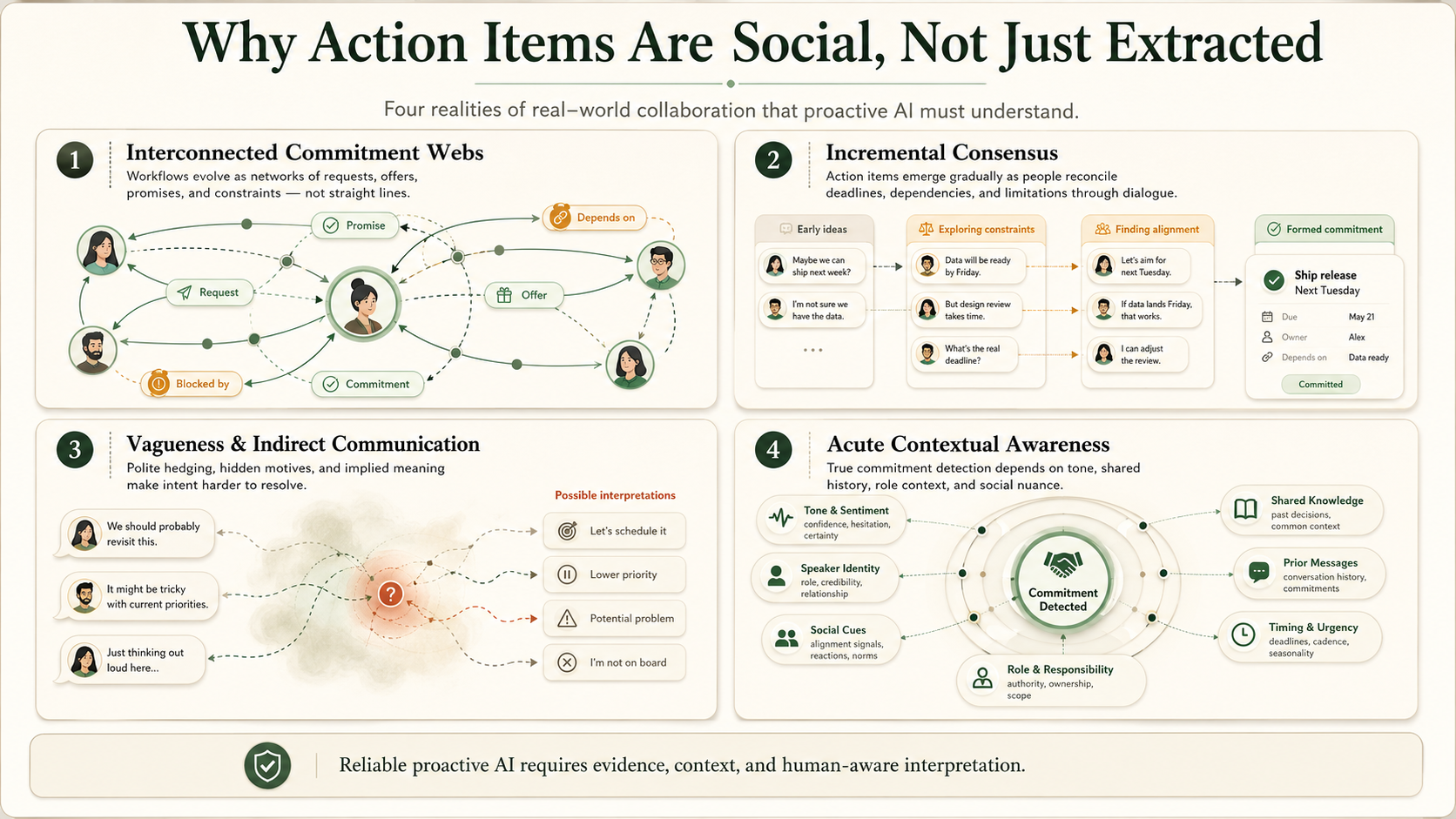
The primary reason AI agents struggle to record our obligations is their fundamental design, which prioritizes processing rules and symbols in isolation from their environment. These systems are built for a sanitized, linear flow of data that does not exist in human collaboration. Instead, human work is defined by intricate social negotiations involving four key complexities:
- Interconnected Commitment Webs: Modern workflows are not straight lines; they are evolving networks of "communicative commitments" requests, offers, and promises that participants continually adjust.
- The Process of Incremental Consensus: It is rare for a task to be fully articulated in one go. Action items emerge slowly through dialogue as stakeholders gradually reconcile various deadlines, dependencies, and limitations.
- Vagueness and Indirect Communication: Professional interactions are often layered with polite hedging, hidden motives, and implicit meanings. To succeed, collaborators must resolve these ambiguities to identify actual intent.
- Acute Contextual Awareness: Pinpointing a specific commitment requires what experts call an "exquisite sensitivity to context," encompassing social nuances, tone, and a vast body of shared knowledge.
Conventional computing platforms lack this refined sensitivity, causing them to overlook the nuanced, socially negotiated framework that human beings use to coordinate their efforts.
Multi-Party Environments: Where AI Context Breaks Down
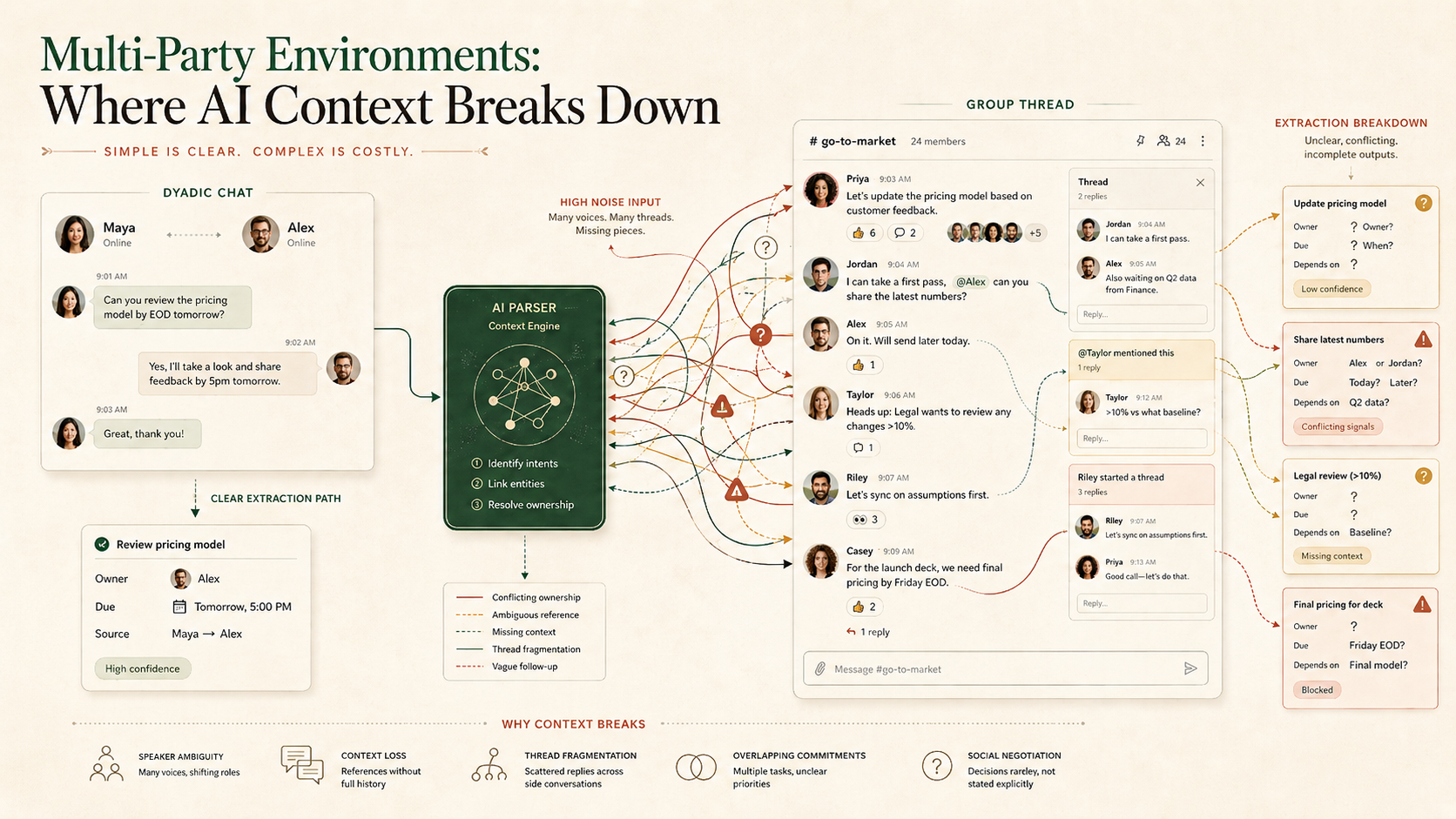
The tension between fluid social negotiation and rigid AI extraction is most visible in multi-user settings. Although AI agents are frequently evaluated in one-on-one (dyadic) scenarios, most professional enterprise work occurs in complex Slack threads and crowded group channels.
AI memory architectures suffer significant performance degradation when implemented in these multi-party environments. Data from the GroupMemBench framework indicates that even the most robust architectures reach only 46.0% average accuracy in such settings. This accuracy drops further to a mere 27.1% when the AI must process "knowledge updates" based on an evolving group consensus.
At the heart of this collapse is the fact that standard AI ingestion pipelines tend to strip away the lexical and structural markers necessary for effective "speaker-grounded belief tracking". Within group conversations, AI systems struggle to distinguish among speakers, achieving only 37.7% accuracy in resolving term ambiguity, a rate that often lags behind basic keyword search tools. Ultimately, the AI fails to grasp the social nuance that User A's commitment may be limited by User B's specific constraints, resulting in task lists that are either misassigned or entirely fabricated.
Automated detection of commitments encounters a definitive limit in reliability, even in instances of clear human speech. This occurs because the point at which a social negotiation transforms into a binding obligation remains a subject of disagreement among human experts.
Conversational "Hard Cases"
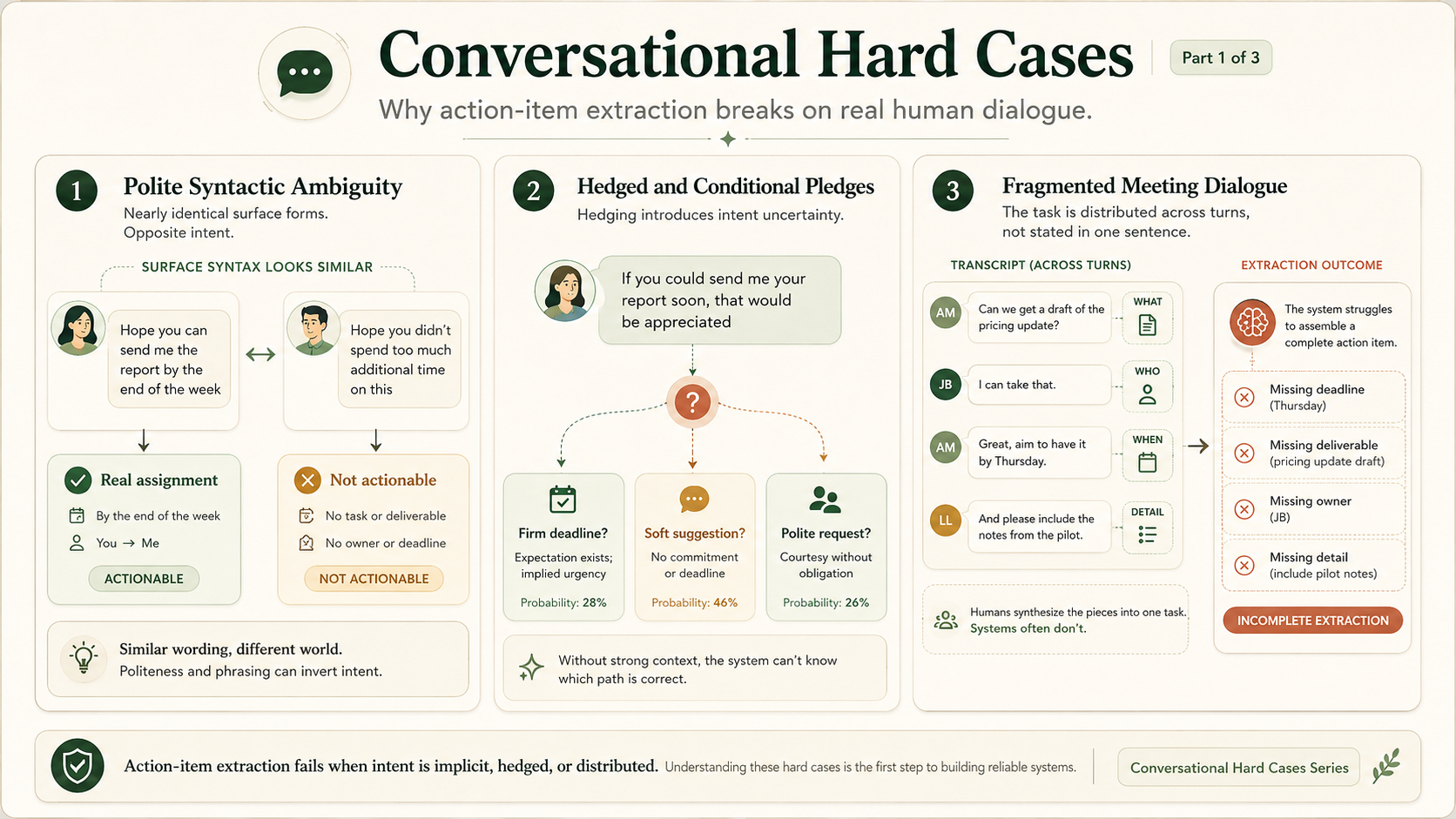
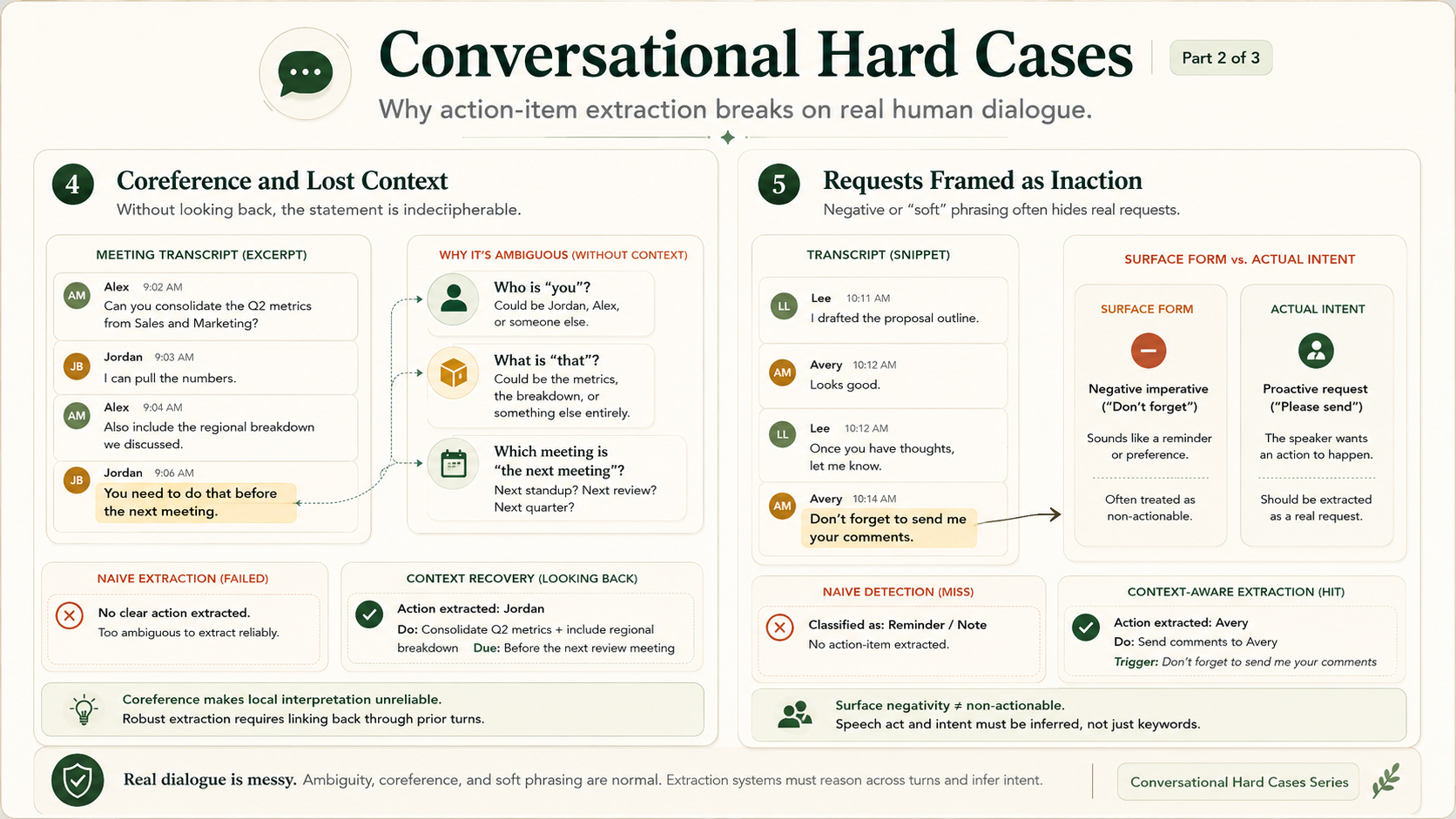
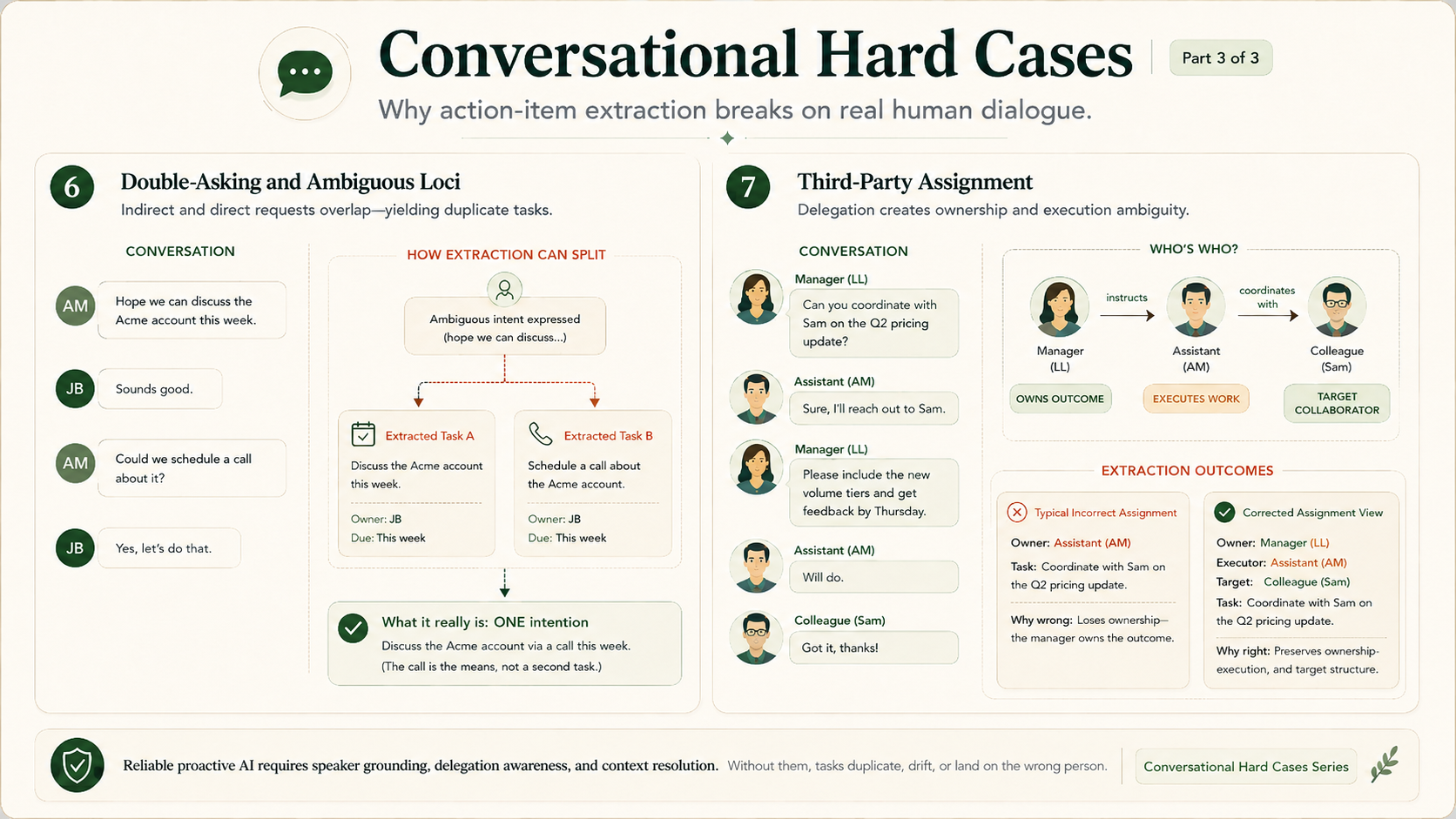
Artificial intelligence frequently falters when navigating the "hard cases" that characterize human social exchange:
- Polite Syntactic Ambiguity: Linguistic pleasantries often mimic task structures. While "Hope you can send me the report by the end of the week" represents a valid assignment, the phrase "Hope you didn't spend too much additional time on this" uses the same pattern despite lacking any actionable intent.
- Hedged and Conditional Pledges: Communication is rarely absolute. Phrases such as "If you could send me your report soon, that would be appreciated" force AI to guess whether it is facing a formal deadline or a mere suggestion.
- Fragmented Meeting Dialogue: Tasks in live discussions are seldom captured in a single sentence. Because action item details are often distributed across several turns, AI struggles to synthesize these fragments into a cohesive whole.
- Coreference and Lost Context: Human speakers rely on shared understanding. A directive like "You need to do that before the next meeting" is indecipherable unless the system can look back through the transcript to identify who "you" is and what "that" entails.
- Requests Framed as Inaction: Extractors tuned for positive verbs often miss the point of negative formulations. "Don't forget to send me your comments" appears to be an instruction not to act on the surface, but the underlying intent is a proactive request.
- Double-Asking and Ambiguous Loci: Speakers frequently pair indirect and direct requests. For instance, mentioning a hope to discuss an account before explicitly requesting a call can confuse AI models, leading to duplicate task creation.
- Third-Party Assignment: Delegation to a third party, such as a manager instructing an assistant to coordinate with another colleague, often results in incorrect ownership assignment in AI systems.
Advancing Proactive AI Architecture Beyond Basic Extraction
To navigate the complexities of ambiguous dialogue and group interactions, the industry is transitioning from simple prompt engineering toward sophisticated, structured reasoning and memory frameworks: Here are some examples,
- Chronos (Temporal Normalization): Phrases such as "by Friday" require conversion into concrete dates, yet LLMs often fail at date calculations in multi-turn threads. The Chronos architecture addresses this through a dual-calendar approach: an "event calendar" for structured data and a "turn calendar" for raw dialogue history. This method enables models to reach 95.60% accuracy on memory-intensive benchmarks.
- (Proactive Memory Loops): Traditional "feed-forward" systems often prematurely summarize conversations, missing vital details. ProMem introduces a recurrent feedback loop where the AI asks internal probing questions to validate facts and recover overlooked information before finalization.
- Neuro-Symbolic Validation: Generative LLMs, while nuanced, are costly and prone to hallucinations. Comparisons indicate that an LLM may take 22,987 seconds to extract interview data (69.4 F1 score), whereas a neuro-symbolic system completes similar tasks in only 69 seconds. Hybrid architectures represent the future, utilizing LLMs for discovery and strict symbolic gates for official task creation.
The Takeaway
While the generative AI era has simplified the production of structured JSON from meeting transcripts, this convenience fosters a misleading perception that action-item extraction is effectively resolved. The true challenge for an AI agent lies beyond mere string extraction; it must grasp the intricate, negotiated nature of human cooperation.
Identifying future obligations is not a search for the ideal text segment. Authentic proactive AI requires structural discipline, employing recurrent verification cycles and evidence-based grounding to either request human validation or abstain when a social negotiation is too vague for autonomous action.